Pearl2026-10-20 08:28:13Pearl pitches a market-based way to price GPU compute as public indexes struggle with H100 valuationsGPU pricing remains hard to pin down even for the same NVIDIA H100, with listed rates varying sharply depending on uptime guarantees, networking, cooling, and the broader compute environment wrapped around the chip. The article argues that this makes standardized pricing and physical-delivery futures difficult, because the underlying product is not a uniform commodity. It points to examples such as CoreWeave borrowing against similar H100 hardware at very different rates depending on whether long-term customer contracts were attached, and notes that public cloud rate cards can sit 40% to 50% above what large buyers actually negotiate. Against that backdrop, Pearl is presented as a Layer 1 blockchain that replaces SHA-256 hashing with GPU-based matrix multiplication while keeping a Bitcoin-style proof-of-work and difficulty adjustment framework. Using a mechanism called NoisyGEMM, the network is designed to prevent miners from shortcutting the work while still making the computation commercially relevant. The piece says 320,000 GPUs are pointed at Pearl, and that their movement between mining and external rental markets creates a continuously updated signal for the opportunity cost of compute. It also cites Together AI’s May 15, 2026 launch of an inference endpoint on Pearl, priced more than 25% below standard cloud rates for Gemma-4-31B-it-Pearl.380
Pearl2026-10-15 23:57:00PRL Jumps More Than 250% in 30 Days as Pearl’s AI Mining Model Faces Its Real TestPearl Research’s token PRL has turned into one of the strongest movers in the AI crypto segment, rising about 64% over the past seven days and nearly 261% over 30 days as of Oct. 14, with a circulating market capitalization of roughly $650 million. The rally has drawn attention to Pearl’s core pitch: a Proof of Useful Work, or PoUW, design that aims to let GPUs handle AI workloads while also producing blockchain mining rewards. The idea is straightforward on paper. Instead of using compute power only for traditional proof-of-work hashing, Pearl replaces that work with matrix multiplication, a core operation used in AI training and inference. That gives GPU operators a shot at earning both AI service revenue and PRL mining rewards from the same hardware. The project has also pointed to a commercial example through its integration with Together AI, which said expected mining rewards allowed more than 25% discounts on certain model API prices. Still, the model has not cleared its biggest questions. Input data cited by CoinW Research Institute shows Pearl has yet to fully prove how much of its compute comes from real paying AI demand rather than synthetic mining activity. PRL’s token structure also adds risk: only about 16.4% of the 2.1 billion maximum supply is in circulation, while roughly 1 million PRL are estimated to be newly issued each day. With fully diluted valuation nearing $4 billion, the project now has to show that revenue, demand and token value capture can keep up with market expectations.520
Stanford Univ2026-10-15 10:58:12Stanford and Together AI introduce NCM, a text generation approach reporting up to 31x faster inferenceResearchers from Stanford University and Together AI have proposed Next-Concept Modeling, or NCM, as a text generation framework that differs from both autoregressive and diffusion models. Instead of producing text token by token or denoising a full sequence over many rounds, NCM first generates a coarse conceptual outline in parallel and then fills in details layer by layer until the final text is reconstructed. The method borrows the idea of next-scale prediction from the NeurIPS 2024 best paper VAR in image generation and adapts it to language with a multi-scale residual VQ-VAE plus a Transformer trained to predict the next layer of representation. In experiments reported in the paper, NCM achieved similar or better quality while delivering substantial speed gains against diffusion language model baselines: about 21x faster on LM1B unconditional generation, about 10x on OpenWebText, and about 31x on XSum summarization at comparable ROUGE-L. The paper also reports better results on hard Sudoku tasks with fewer generator calls. The authors note that key questions remain, including whether the approach keeps its advantages at larger scales and how well it handles precise or long-form text generation.460
Pearl2026-10-11 02:48:00Pearl pitches a market-based price signal for GPU compute through on-chain mining activityGPU pricing remains hard to standardize because an H100 hour is not a uniform product. Public indexes tracked on Bloomberg terminals may follow listed rental rates, but the underlying service can vary sharply by networking, uptime, cooling, facility quality, and contract structure. The article cited by PANews argues that this makes both spot indexes and futures design difficult, especially when large buyers often negotiate prices 40% to 50% below public rate cards. Against that backdrop, the piece points to Pearl, a Layer 1 blockchain that uses GPU-based matrix multiplication rather than SHA-256 hashing in its proof-of-work process. According to the article, Pearl’s network has 320,000 GPUs, and their collective decision to mine on Pearl or leave for external rental markets creates a live opportunity-cost signal for compute. The network updates around every 194 seconds, which the article presents as a continuous benchmark for real-world AI compute under actual power, cooling, and networking conditions. The piece also describes Pearl’s NoisyGEMM design, which adds structured noise to prevent miners from shortcutting matrix multiplication while still allowing the system to recover useful work. It further notes that Together AI announced an inference endpoint on May 15, 2026, offering Gemma-4-31B-it-Pearl at more than 25% below standard cloud rates by combining inference revenue with Pearl mining rewards.530
Pearl2026-10-10 05:00:56Why Pearl Became One of the Most Mentioned Projects at Token2049Pearl has become a frequent topic at Token2049, largely because it sits at the intersection of two strong themes in 2026: AI and fair launch. The project pitches itself as a Proof-of-Useful-Work network, where miners use GPU power for matrix multiplication rather than conventional hash calculations, with the idea that mining could also support AI inference. That narrative has helped Pearl earn comparisons to an "AI-native Bitcoin" among supporters. Bulls point to three main arguments: a sovereign-free digital asset backed by compute and energy, a mining model aligned with AI-driven energy demand, and a "2-for-1" unit economy in which one GPU workload could generate both inference revenue and PRL rewards. The pushback is more technical. Pearl’s own design, as described in the source text, can verify that matrix multiplication happened, but not whether the work was tied to an actual AI inference task. Critics argue this opens the door to "job-binding failure," where miners can perform cheaper random matrix calculations instead of useful inference while still receiving rewards. The article also cites research involving 8,012 miner nodes and 44 accepted shares generated from random matrices. Pearl’s team has acknowledged that the chain currently has no onchain metric for measuring the share of useful mining and argues the economics could improve through future protocol upgrades. That leaves Pearl positioned less as a settled AI infrastructure play and more as a high-conviction bet on whether AI inference and GPU mining can eventually merge into one system.3830
Pearl2026-10-09 04:13:19Pearl says AI inference and PoW mining can run on the same GPU. The network still appears dominated by random matrices.Pearl is pitching a narrow but ambitious idea: replace hash-based proof-of-work with matrix multiplication so the same GPU workload can both secure a blockchain and produce verifiable AI computation. The standalone PoW chain, whose token is PRL, argues that one batch of neural-network style multiply-accumulate operations can generate block rewards and useful inference at the same time. The project has already released certified model variants on Hugging Face, open-sourced code, and launched a Gemma-based API with Together AI that, according to Together’s announcement, is priced 25% below a standard endpoint with the discount offset by the token’s future value. The harder question is whether the network is actually doing useful AI work. A June 2026 paper by researcher Abhinaba Basu, titled The Usefulness Gap in Proof-of-Useful-Work, estimated Pearl’s network at roughly 24 EH/s at the time, equivalent to about 320,000 RTX 3090-class GPUs and 112 megawatts of power draw, while concluding that useful AI output was zero. The paper sampled 8,012 miner work units, found matrix-multiplication related strings but no machine-learning framework strings in major mining software, and showed that a custom miner using randomly filled matrices could still win accepted shares. That leaves Pearl facing its central problem: the protocol can verify that a matrix product was computed, but not that the input matrices came from a real customer task rather than synthetic data. The project’s bet is that inference demand will eventually make real jobs more profitable than filling random numbers. Until then, critics argue, Pearl remains a GPU mining chain with different math rather than a network delivering meaningful AI compute at scale.550
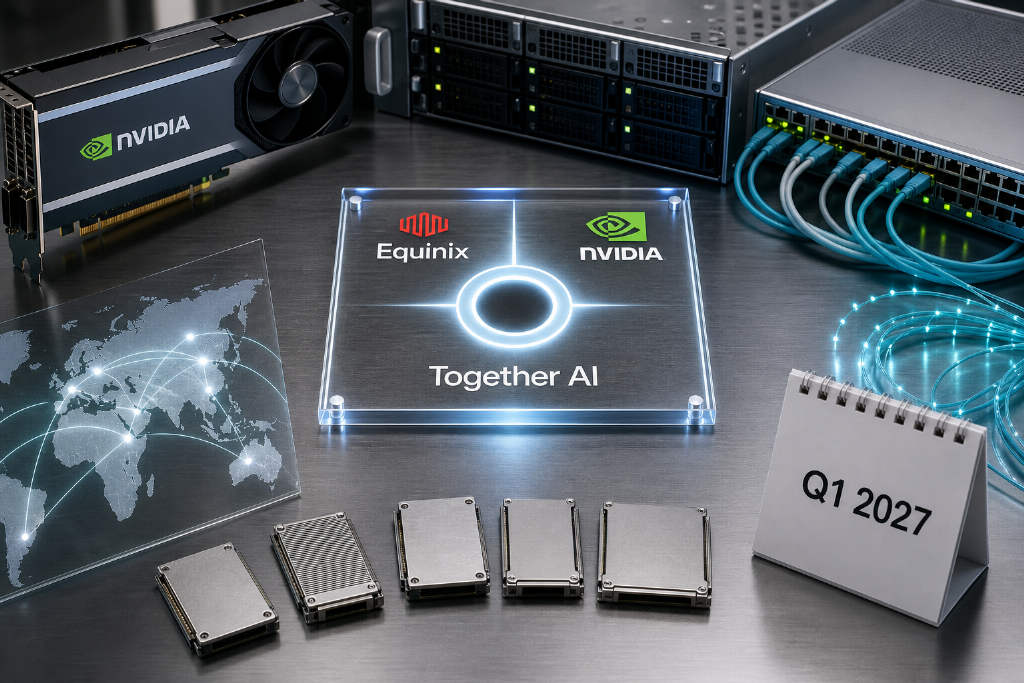
Equinix2026-09-02 12:19:54Equinix, Nvidia, and Together AI to Build AI Inference Exchange, Launching Q1 2027Data center operator Equinix is partnering with Nvidia and AI startup Together AI to create an AI inference exchange. The platform aims to offer enterprises more flexible AI model deployment options and is scheduled for launch in the first quarter of 2027. The initiative seeks to enhance global data accessibility and reduce reliance on single vendors, potentially reshaping enterprise AI deployment.1110
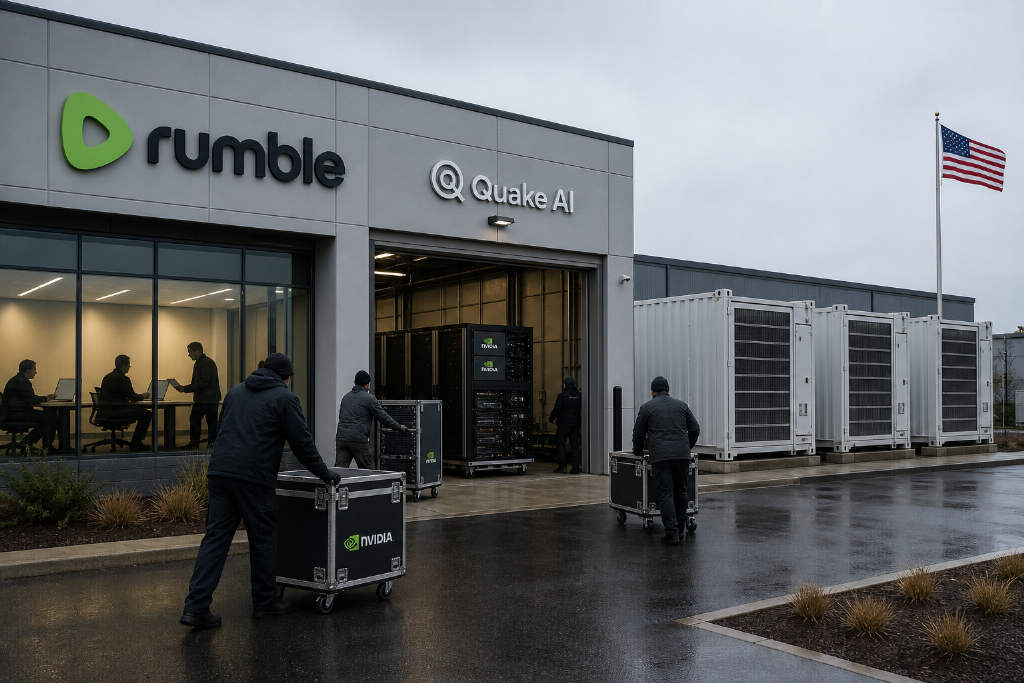
RUM Group2026-08-24 12:14:08RUM Group signs $13.7 billion six-year GPU services dealRUM Group, formerly Rumble Inc., has signed a six-year GPU services agreement with a U.S. cloud customer worth about $13.7 billion, according to Techub News, citing CryptoBriefing. The deal includes a warrant provision that gives the customer the right to buy more than 50.8 million Class A shares at $0.01 per share. Exercise terms are tied to actual service purchases and any potential expansion agreements. The contract will be carried out in three tranches of roughly $4.6 billion each, with final delivery dates subject to customer approval. The GPU services covered by the agreement will support the company’s Quake AI division. Techub also said RUM Group acquired about 85.2% of Northern Data AG and 22,000 NVIDIA GPUs in June this year. Based on the figures cited, the new contract is about 50 times larger than the company’s earlier $270 million agreement with Together AI.1370